In today’s fast-moving digital world, short messages rule conversations. Whether you’re chatting with friends, texting casually, or scrolling through social media, abbreviations are everywhere. One of the most common yet slightly confusing ones is MK meaning in text.
You might have seen someone reply with just “MK” and wondered—what does it really mean? Is it agreement? Is it sarcasm? Or something else entirely? 🤔
This complete guide will break everything down for you in a simple, expert, and easy-to-understand way. By the end, you’ll not only understand the meaning but also how to use it naturally like a pro.
What Does MK Mean in Text? 💡
MK is a casual slang abbreviation that usually means “Okay” or “Mm, okay”.
It’s often used in texting to show agreement, acknowledgment, or sometimes mild disinterest depending on tone.
- MK = Okay
- MK = Got it
- MK = Fine
It’s shorter than typing “okay” and fits perfectly in quick conversations.
“MK is like saying okay, but with less effort and sometimes more attitude.”
Origin of MK in Texting 📜
The abbreviation MK comes from the spoken phrase “mm-kay”, which has been used in casual English for decades.
It gained popularity in online chats and SMS texting when people started shortening words for faster typing. Over time, it became a standard response in digital conversations.
Its widespread use increased with:
- SMS texting era 📱
- Social media platforms
- Instant messaging apps
Different Meanings of MK in Text 🔍
Although MK meaning in text is usually “okay,” context can slightly change its tone.
1. Simple Agreement ✔️
Used to confirm something casually.
Example: “Meet me at 6?” → “MK”
2. Acknowledgment 👌
Shows you understood the message.
Example: “Send the file today.” → “MK”
3. Mild Disinterest 😐
Sometimes it sounds less enthusiastic.
Example: “I’ll be late again.” → “MK”
4. Passive Response 😶
Used when someone doesn’t want to argue.
How MK Is Used in Real Conversations 💬
Let’s look at real-life chat examples to understand how people use MK:
- Friend: “Let’s watch a movie tonight”
You: “MK 👍” - Boss: “Please update the report”
You: “MK” - Sibling: “I ate your snacks”
You: “MK 😑”
The tone depends heavily on the situation and relationship between people.
MK vs OK vs K: What’s the Difference? ⚖️
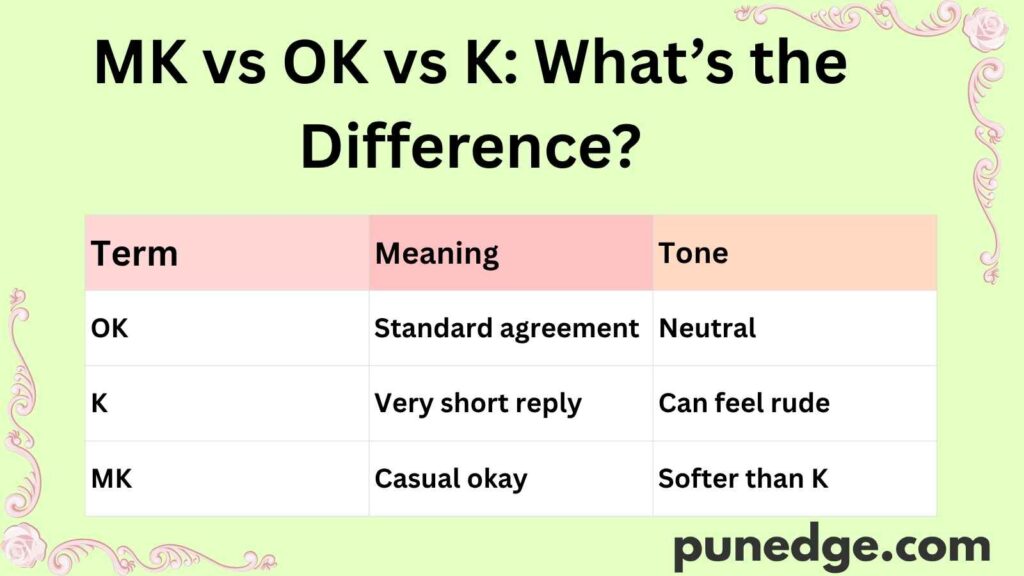
| Term | Meaning | Tone |
|---|---|---|
| OK | Standard agreement | Neutral |
| K | Very short reply | Can feel rude |
| MK | Casual okay | Softer than K |
MK feels more relaxed and natural than just “K.”
When Should You Use MK? 🕒
You can use MK in many situations, but it works best in casual chats.
- With friends 👯
- In informal conversations
- Quick replies
Avoid using it in:
- Formal emails ❌
- Professional communication ❌
When NOT to Use MK 🚫
Even though MK is popular, it’s not always appropriate.
- Job interviews
- Client conversations
- Academic writing
In these cases, use full words like “Okay” or “Understood.”
Is MK Rude or Polite? 🤷♂️
The answer depends on tone and context.
It can feel:
- Polite → when used casually
- Rude → when used without emotion
- Neutral → in everyday chat
For example:
“Thanks for helping!” → “MK” (can feel dismissive)
So, always consider how it might sound to the other person.
Psychology Behind Short Replies 🧠
Short replies like MK are popular because they:
- Save time ⏱
- Reduce effort
- Keep conversations quick
However, they can sometimes create misunderstandings because tone is missing.
“In texting, fewer words often mean faster replies—but not always clearer communication.”
MK in Social Media & Online Culture 🌐
MK is widely used across platforms like:
- Chat apps
- Comments sections
- Gaming chats 🎮
It’s part of modern internet language that values speed and simplicity.
Common Mistakes When Using MK ⚠️
- Using it in formal situations
- Sounding uninterested accidentally
- Overusing it in conversations
Balance is key when using slang like MK.
Similar Slang Words to MK 🔄
- OK
- K
- Alright
- Got it
- Sure
Each has a slightly different tone, so choose wisely.
Expert Tips to Use MK Naturally 💡

- Use emojis to soften tone 😊
- Combine with words when needed
- Avoid using it alone in serious chats
Example: “MK 😊” feels friendlier than just “MK”.
FAQs: ❓
1. What does MK mean in texting?
It means “okay” or “mm okay” in casual conversation.
2. Is MK rude?
It can feel rude depending on tone and context.
3. Can I use MK professionally?
No, it’s best for casual conversations only.
4. Why do people use MK instead of OK?
Because it’s quicker and feels more conversational.
5. Is MK the same as K?
No, MK feels softer and less blunt than K.
Conclusion:✨
Understanding MK meaning in text helps you communicate better in modern digital conversations. While it simply means “okay,” its tone can change depending on how and where you use it.
Always remember—context matters. A small word like MK can either feel friendly or distant.
So next time someone texts “MK,” you’ll know exactly what they mean—and how to reply confidently! 💬