By Khaleda Rahman
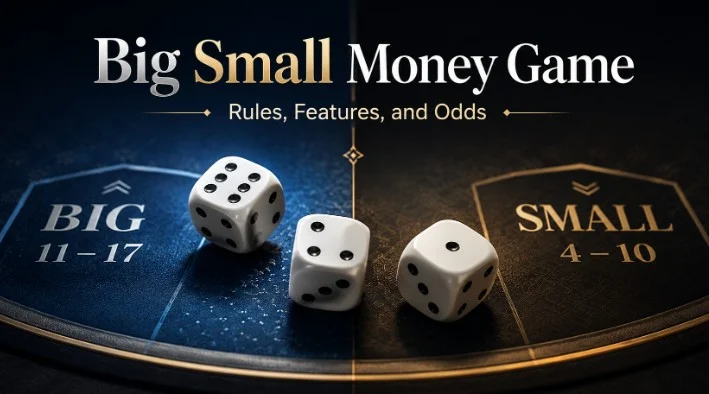
The Big Small money game is a simple dice casino game. Players predict the result before three dice are rolled. The basic idea is easy to understand, but the odds can make the game more complex. Big Small Casino Royale uses the same three-dice format and adds features like Extra Pay and the Double Game. These features can change how a round works, but the final dice result is still random. People searching for a big small game download may encounter different versions of Big Small-style games across casino platforms and game libraries. Before trying any version, learn the basic rules, bets, payouts, and odds. Do not rely only on screenshots or short descriptions. This guide explains how the Big Small money game works, what Big and Small bets mean, how extra features work, and what to know about probability and common prediction myths.
What Is the Big Small Money Game?
The Big Small money game uses three dice. Players predict which type of result will appear. The rules are simple and easy to understand. However, it is also important to know the odds behind each roll. This helps explain how the game really works.
Basic Concept of Big Small Casino Royale
Big Small Casino Royale uses three dice. In each round, all three dice are rolled, and their total determines the result. Players do not need to guess the exact value of every die. Instead, they usually choose between broader options such as Big or Small. The goal is simple: pick an outcome before the roll and see if the final result matches your choice. This makes the game easier to understand than casino games with complex card rules or large betting tables. However, simple rules do not make the results predictable. Each roll can still produce many different combinations.
Why the Game Is Based on Dice Probability
A standard die has six possible values. With three dice, there are many more possible combinations. Each die works independently. The result of one die does not affect the others. The same is true between rounds. A Big result does not make Small more likely in the next round. This matters because many Big Small strategies try to find patterns in past results. Random dice rolls do not reliably predict what will happen next.
How the Big Small Money Game Works
A round of Big Small follows a short sequence. Choose a prediction and place your bet. Then three dice are rolled to decide the result. Knowing these basic steps makes the game easier to understand, including its extra features and betting options.
Starting a Round
A typical round begins with the player selecting one of the available betting options. Depending on the specific version, the interface may display Big, Small, or other possible selections. The player chooses an option and enters a stake before the betting period closes. The game then rolls three dice. Once the dice stop, their values are checked against the rules for the selected bet. If the combination meets the required conditions, the selection wins. If it does not, the stake is lost. The entire process usually takes only a short time, which is why Big Small-style games tend to have a fast round structure.
How the Result Is Calculated
The outcome is determined by the final values of all three dice. In many versions, the dice values are added together to decide whether the result is Big or Small. Some combinations may follow different rules. Three matching dice, called a triple, can be treated separately in certain games. This means not every Big Small game uses the same calculation method. Always check the paytable and game rules to see how each result is handled.
Big and Small Betting Options Explained
Big and Small are the central prediction options in this type of dice game. Although the two choices may look simple, special combinations and game-specific rules can influence whether a result qualifies.
What a Big Result Means
A Big result usually means the total of all three dice falls in the higher range. The exact numbers depend on the game rules. For example, if the dice show 6, 4, and 3, the total is 13. If 13 is inside the Big range, the Big bet wins. Big does not usually mean that one die must show a high number. It refers to the combined total of all three dice.
What a Small Result Means
Small works in the opposite way. It covers the lower section of the qualifying three-dice totals. If the total lands within that range, the Small prediction wins, assuming no special combination changes the result. For example, a roll showing two, three, and two creates a relatively low total. In many Big Small rule systems, this type of result would belong to the Small category. The exact range should always be confirmed using the rules of the particular game.
Special Dice Combinations
Special dice combinations can change both the odds and the payout. A common example is a triple, where all three dice show the same number. This could be three twos, three fours, or three sixes. Some three-dice games do not count triples as normal Big or Small results. Others use separate rules or payouts for them. This changes the real chance of winning a Big or Small bet. So even if the game looks like a simple two-choice format, the two sides may not always have exactly the same odds.
Extra Pay Feature in Big Small Casino Royale
Extra Pay adds another layer to the standard Big Small format by giving certain qualifying results different payout conditions. The feature affects potential returns, but it does not make random dice outcomes easier to predict.
How Extra Pay Works
Big Small Casino Royale includes an Extra Pay feature that can increase payouts in certain situations. It does not guarantee a bonus on every round. A higher payout is only available when specific game conditions are met. This means players should look at both the possible reward and how often the required event can happen. A larger payout does not automatically mean a better chance of winning.
When Extra Pay Can Be Triggered
The rules for Extra Pay can vary between versions of Big Small Casino Royale. Check the game info or paytable to see how the feature starts, which results qualify, and how it changes the payout. Some versions may also use special dice combinations. Do not assume Extra Pay works the same way in every Big Small game. A higher possible payout also does not mean a higher chance of winning.
Double Game Feature Explained
The Double Game gives players another choice after a win. They can keep their winnings or risk them for a chance to win more.
What Happens After a Winning Round
The Double Game adds extra risk after a win. Instead of keeping the full payout, the player can use it in another round. If the Double Game wins, the payout can increase. If it loses, part or all of the previous win may be lost. The exact result depends on the game rules.
Risk and Reward in the Double Game
The Double Game adds more risk because a win is placed at stake again. A player can use the amount from a completed win for another round. If that round wins, the return can increase. If it loses, the previous gain can disappear. Repeating the Double Game increases the risk even more. It can raise the possible payout, but it does not improve the basic chance of making a profit. Taking the original win is therefore very different from risking it again.
Big Small Money Game Odds and Probability
Probability is one of the most important parts of understanding the Big Small money game. Looking at the possible dice combinations explains why some totals occur more often than others and why the main betting options are not necessarily equal.
How Many Outcomes Are Possible With Three Dice?
Three standard six-sided dice can create 216 possible ordered outcomes. This total includes every possible arrangement of the three dice. Two combinations can have the same total while still being different outcomes because the numbers appear in a different order. Some totals appear more frequently than others because there are more combinations that can produce them. Middle-range totals are generally more common, while extreme totals at the very bottom or top of the range have fewer possible combinations. This distribution is an important part of understanding the probability behind the game.
Why Big and Small Outcomes May Not Be Exactly 50/50
At first glance, choosing Big or Small can look similar to a simple two-sided prediction. That comparison can be misleading. Special outcomes such as triples may be excluded from ordinary Big and Small bets. If that happens, the probability of winning is affected. Payouts may also be set below the mathematically fair value. These rules allow the game to maintain a house advantage even when the two main choices appear almost symmetrical. Players should therefore look at the complete rules rather than assuming that two available choices create equal or fair odds.
House Edge and Expected Return
The house edge represents the statistical advantage built into a casino game. RTP, or return to player, describes the theoretical proportion of stakes that may be returned to players over a very large number of rounds. Neither value predicts what will happen during one short session. A player can win several rounds in a row even in a game with a house edge. Another player can lose several rounds quickly. Short-term results can differ significantly from long-term mathematical averages.
Can You Predict Big Small Game Results?
Many players look at previous results and try to identify patterns that might reveal what comes next. However, properly randomized dice rolls do not become more predictable simply because a particular sequence has already appeared.
Why Previous Dice Rolls Do Not Predict the Next Round
Each properly randomized round is independent. If several Big results appear in a row, it can be tempting to think that Small is now due. This is known as the gambler’s fallacy. Previous results do not force future dice to compensate for a streak. If the underlying probability remains unchanged, the next round still follows the same rules as every other independent round. The same issue applies in the opposite direction. A player may see several Big results and believe that Big is currently more likely to continue. That does not provide a mathematical reason to expect another Big result.
Common Big Small Prediction Myths
Some players use different strategies to predict Big Small results. They may switch between Big and Small after each round or follow the result that appears most often. Others look for repeating patterns or track specific dice numbers and triples. These methods can seem logical, but they cannot control random dice rolls. A pattern in recent results may appear only by chance and does not guarantee what will happen next.
Big Small Money Game Strategies: What Can and Cannot Be Controlled

There is no strategy that can determine the next random dice result, but players can control how much money and time they expose to the game. Practical bankroll management is therefore different from attempting to predict outcomes.
Managing Stake Size
Players cannot control which numbers appear on the dice, but they can control how much they risk. Using a fixed stake is one simple approach. Instead of increasing the wager after every loss, the same amount can be used across several rounds. This does not improve the probability of winning, but it makes the amount of money exposed easier to track. Rapid stake increases can produce much larger losses when an unfavorable sequence occurs.
Setting Win and Loss Limits
A predefined session budget can help separate bankroll management from attempts to predict results. A loss limit establishes the maximum amount that will be risked during one session. A win limit can also provide a point at which the session ends instead of repeatedly exposing previous gains to additional rounds. These limits do not change the mathematical structure of the game. Their purpose is simply to control financial exposure.
Understanding the Double Game Risk
The Double Game deserves particular attention because it encourages an additional decision immediately after a win. A player may win and then successfully increase that amount through the Double Game. The larger balance can create an incentive to try again. Each additional attempt, however, exposes the accumulated amount to another random result. Potential winnings may increase quickly, but so can the amount that disappears after one unsuccessful attempt.
Demo Play vs Real-Money Big Small Games
Demo and real-money versions can use similar rules and interfaces, but they serve different purposes. Demo play is mainly useful for learning the mechanics without placing actual funds at risk.
What a Demo Version Can Teach
A demo version can help users understand the interface, betting options, dice animations, result display, Extra Pay feature, and Double Game mechanics. It can also make it easier to find the paytable and learn how different outcomes are classified before using real money. For this reason, demo play can be useful as an educational tool for understanding how the game operates.
What Demo Play Cannot Demonstrate
Demo play cannot prove that a betting strategy is profitable. A short sequence of virtual wins does not indicate that the same pattern will continue. Likewise, winning repeatedly in a demo session does not mean a player has discovered a reliable prediction method. Random variation can produce unusually good or bad runs over relatively small numbers of rounds. The mathematical rules remain more informative than short-term demo results.
How Big Small Casino Royale Differs From Traditional Sic Bo
Big Small Casino Royale shares its basic three-dice concept with Sic Bo, but the two formats are not always identical. Comparing them helps clarify which mechanics are traditional and which belong specifically to Big Small Casino Royale.
Similarities
Big Small Casino Royale shares several characteristics with Sic Bo. Both games use three dice and can include predictions based on the combined dice values. Big and Small are also familiar betting categories in traditional Sic Bo. As a result, anyone who understands basic Sic Bo mechanics will probably recognize the central concept immediately.
Differences
Big Small Casino Royale uses a more focused game structure. Traditional Sic Bo can contain a large betting table with predictions covering totals, individual numbers, doubles, triples, pairs, and specific combinations. Big Small Casino Royale may place more emphasis on a smaller selection of main predictions. It also distinguishes itself through features such as Extra Pay and the Double Game. These additions make it different from a basic three-dice table even though the underlying random event remains the same.
Important Terms in the Big Small Money Game
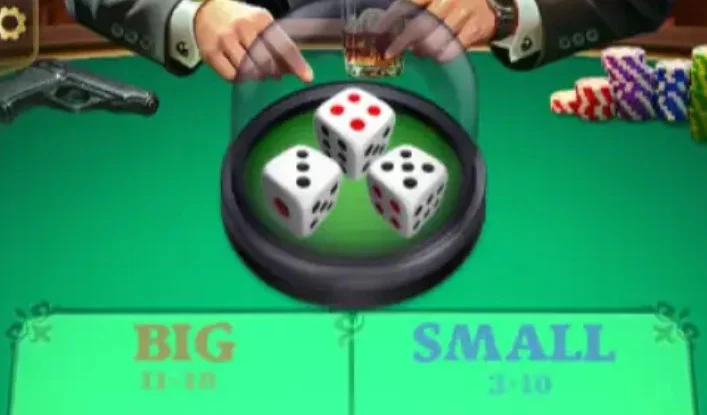
Understanding the most common terms makes the game rules and paytable easier to read. The core vocabulary is connected with dice results, payouts, probability, and additional features.
Big
Big refers to a prediction covering the higher qualifying range of three-dice totals.
Small
Small refers to a prediction covering the lower qualifying range.
Dice Total
The dice total is the combined value of all three dice after they stop.
Triple
A triple is a result in which all three dice show the same number.
Payout
A payout is the amount returned when a qualifying selection wins.
Odds
Odds describe the relationship between probability, risk, and potential return.
Extra Pay
Extra Pay is a Big Small Casino Royale feature that can provide enhanced payout conditions for qualifying outcomes.
Double Game
The Double Game is a feature that allows a previous win to be placed at risk again for the possibility of increasing its value.
RTP
RTP means return to player. It describes the theoretical proportion of stakes returned over a large sample of gameplay.
House Edge
The house edge is the mathematical advantage built into the game in favor of the operator.
Responsible Approach to Big Small Money Games
Because Big Small is based on random dice outcomes, it is important to distinguish entertainment from attempts to generate predictable income. Practical limits can help control both financial exposure and session length.
Treating the Game as Chance-Based Entertainment
The outcome of a Big Small round is based on random dice results. No betting method can force the dice to produce a specific combination. Increasing a stake also does not make a selected outcome more likely. A larger wager changes only the amount exposed to the result. For that reason, Big Small is better understood as a chance-based game rather than as a reliable way to make money.
Setting Practical Limits
Financial and time limits can reduce unnecessary exposure. A practical approach is to decide on a budget before starting, avoid using money needed for essential expenses, set a maximum session duration, and stop when the predetermined limit has been reached. It is also important to avoid increasing stakes simply to recover previous losses. Loss-chasing can cause the amount at risk to rise much faster than expected.
Conclusion
The Big Small money game uses three dice and simple Big or Small predictions. The rules are easy to learn, but the game still involves probability and risk. Players choose an outcome, the dice are rolled, and the final total decides the result. Big Small Casino Royale adds features such as Extra Pay and the Double Game. These can increase possible payouts, but they also increase risk. The best way to understand the game is to learn the rules, paytable, and special combinations. Three dice can create many different outcomes, and some combinations may affect the real odds. Previous rolls cannot predict the next result, and betting systems do not make random dice predictable. Learning the probabilities and managing your stake is more useful than looking for winning patterns.