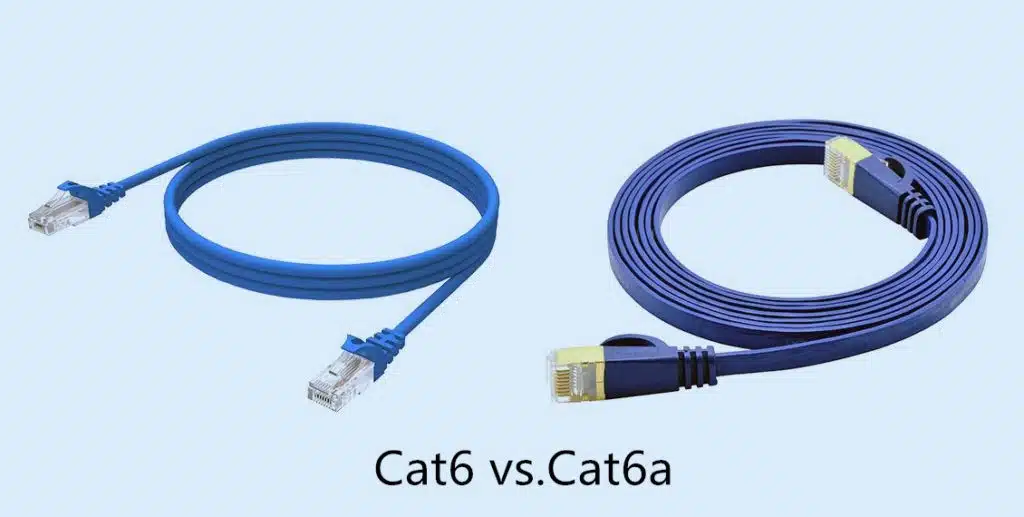
When a business plans a new network, upgrades an office, or expands into a larger facility, the cable category can affect performance for years. The question of Cat 6 vs Cat 6A is not just about choosing the higher-rated category. It is about matching cable performance to speed requirements, run length, installation conditions, Power over Ethernet needs, and future network growth.
For many business networks, Cat 6 cable still provides reliable performance for everyday applications. Cat 6A cable, however, offers more headroom for 10 Gigabit Ethernet across longer distances. Understanding where each cable fits can help IT managers, contractors, and facilities teams make a better infrastructure decision before installation begins.
What Is the Difference Between Cat 6 and Cat 6A?
Cat 6 and Cat 6A are both twisted-pair Ethernet cable categories used in structured cabling systems. Cat 6 is commonly used for Gigabit Ethernet and shorter 10 Gigabit Ethernet links, while Cat 6A provides more bandwidth and supports 10 Gigabit Ethernet over the full 100-meter channel when installed with compatible components.
In simple terms, Cat 6A provides higher bandwidth and stronger support for longer 10G links. Cat 6 may be more practical when the network does not require full-distance 10G performance, when pathways are tight, or when budget and installation flexibility are major considerations.
Cat 6 Cable: Where It Fits Best
Cat 6 cable is widely used in offices, retail spaces, schools, and commercial buildings where Gigabit Ethernet remains the primary need. It is typically rated to 250 MHz and supports 1 Gigabit Ethernet up to 100 meters under standard conditions.
Cat 6 can also support 10GBASE-T in shorter channels, depending on installation quality, cable bundling, interference, and the total link length. This makes it a reasonable option for smaller offices, workstation drops, voice and data runs, point-of-sale systems, and many general business applications.
Cat 6 may be a good fit when:
- The network mainly supports 1 Gigabit Ethernet
- Cable runs are not expected to require full-distance 10G
- Pathway space is limited
- The project needs a balance of performance and cost
- Future upgrades are expected but not immediate
The practical advantage of Cat 6 is that it can be easier to install than larger cable constructions. It is often more flexible than Cat 6A, which can matter in crowded ceilings, conduit, wall cavities, and telecommunications rooms.
Cat 6A Cable: When the Extra Headroom Matters
Cat 6A cable is typically rated to 500 MHz and is built to support 10 Gigabit Ethernet over a full 100-meter channel. The “A” stands for augmented, and that added performance is especially useful in environments where bandwidth demand is expected to grow.
Cat 6A is often selected for larger offices, healthcare facilities, data-heavy business environments, schools, warehouses, and buildings that need stronger long-term network capacity. It can also be a good choice for wireless access points, security systems, AV equipment, and other devices that may demand more bandwidth over time.
Cat 6A may be the better choice when:
- The project requires 10 Gigabit Ethernet at longer distances
- The building needs more future-ready infrastructure
- Wireless access points or high-bandwidth devices are being upgraded
- Pathways can support the larger cable size
- The installation budget allows for higher-performance cabling
Commercial Ethernet Cable Decisions Should Consider the Whole Channel
A reliable commercial ethernet cable decision should account for the full cabling channel, not just the cable jacket. The channel includes horizontal cable, patch cords, connectors, patch panels, jacks, pathways, terminations, and testing.
A higher-performing cable will not deliver its intended performance if the rest of the system is not matched to the same category. For example, using Cat 6A cable with lower-rated components may limit the final channel performance. The entire system should be specified, installed, and tested as a complete network pathway.
Project teams should review:
- Maximum run length
- Required network speed
- Cable pathway conditions
- Conduit and tray capacity
- Power over Ethernet requirements
- Electromagnetic interference concerns
- Patch-panel and telecom-room space
- Future device and bandwidth needs
This is where a practical ethernet cable comparison becomes more useful than a simple “better or worse” answer. Cat 6 and Cat 6A both have valid use cases. The right choice depends on the building, the network design, and the expected life of the installation.
PoE, Wireless Access Points, and Device Density
Modern business networks often support more than desktop computers. They may also power wireless access points, security cameras, access control systems, phones, sensors, and AV equipment. Many of these devices rely on Power over Ethernet, or PoE, which allows power and data to travel over the same cable.
PoE planning can affect cable selection because heat can build up in large cable bundles, especially in higher-power applications. Cable construction, conductor size, bundle size, installation environment, and equipment requirements should all be reviewed before the final specification is selected.
Device density also matters. A small office with a few standard workstations may not need the same cabling strategy as a multi-floor building with high-density wireless coverage, camera systems, conference rooms, and planned technology upgrades.
Shielded cable should be selected only when the environment, grounding plan, and connected hardware support that choice.
Common Mistakes When Comparing Cat 6 vs Cat 6A
One common mistake is choosing the cable category based only on today’s internet speed. The internal network may need more capacity than the internet connection, especially when users access servers, cloud platforms, video systems, file storage, or building technology.
Another mistake is assuming Cat 6A is always the best answer. While Cat 6A offers more performance headroom, it may be unnecessary for every run. Overbuilding can increase material cost, labor complexity, and pathway challenges without creating a meaningful benefit in every space.
A third mistake is mixing components without confirming the final channel rating. Cable, patch cords, jacks, and panels should work together. If the project requires Cat 6A performance, the installed system should be designed and tested accordingly.
When Cat 6 May Be Enough
Cat 6 may be enough where Gigabit Ethernet is sufficient and the building does not require full-distance 10G links. It can be a practical choice for general office drops, small business networks, lower-density environments, tight pathways, and projects that need to control cost while still using a modern structured cabling category.
When Cat 6A Is Worth Considering
Cat 6A is worth considering when the network needs more long-term flexibility. If a business expects higher bandwidth demands, denser wireless access point coverage, more connected devices, or longer 10G runs, Cat 6A can reduce the likelihood of needing to recable later.
It is also useful for projects where cabling will be difficult to replace once walls, ceilings, or production areas are finished. In those cases, the extra planning and installation effort may be worthwhile because the infrastructure has to serve the building for many years.
Installation Planning for Cat 6A
Cat 6A cable is generally larger and less flexible than Cat 6. It may require more careful planning for conduit fill, bend radius, cable tray capacity, termination space, and patch-panel organization.
How to Make the Right Ethernet Cable Comparison
The best ethernet cable comparison starts with the actual network requirements. Instead of asking which cable is universally better, teams should ask what the building needs now and what it may need during the expected life of the cabling system.
A useful decision process includes:
- Confirm the required network speeds.
- Map the longest cable runs.
- Review pathway space and bend-radius limits.
- Identify PoE devices and high-bandwidth equipment.
- Match connectors, patch panels, and patch cords to the cable category.
- Consider future wireless, security, AV, and workstation upgrades.
- Confirm testing requirements before installation is complete.
For teams evaluating commercial ethernet cable options, suppliers such as Commodity Cables LLC can be a resource for comparing category cable constructions, availability, and project requirements in a practical way.
Choosing Cable Based on the Network You Are Building
The Cat 6 vs Cat 6A decision should be based on performance requirements, installation conditions, and future network expectations. Cat 6 cable remains a strong choice for many standard business networks, while Cat 6A cable provides additional headroom for higher-capacity infrastructure planning.
Neither option is right for every project. A thoughtful comparison of speed, distance, pathway capacity, PoE needs, and upgrade plans will lead to a better cabling decision than choosing by category name alone.