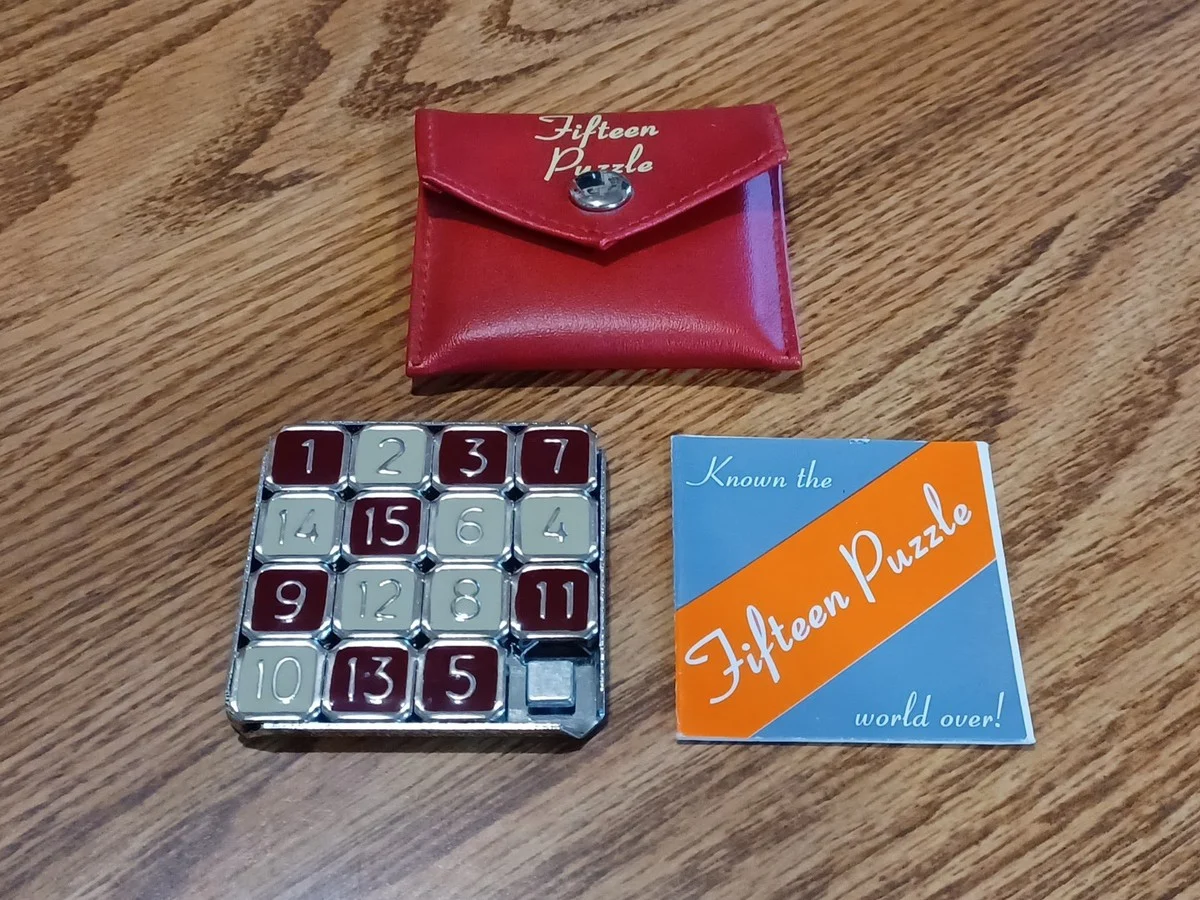
It’s a small plastic tray with fifteen numbered tiles and one empty space. You slide the tiles around until they’re in order. Children play it on car trips; it comes free in cereal boxes. And yet this humble toy, invented in the 1870s, quietly became one of the most important teaching tools in the history of computer science. The story of how that happened is a neat lesson in how simple things hide deep problems.
A craze, and a prize that could never be won
When the 15-puzzle first swept America and Europe in the early 1880s, it triggered a genuine mania. Newspapers reported people neglecting work over it. One puzzle-maker famously offered a large cash prize to anyone who could solve a specific starting position — with only two tiles swapped from the finished state.
Nobody ever collected. As mathematicians soon proved, that particular arrangement was impossible to solve: it sat in the unreachable half of all configurations. The prize was safe precisely because the puzzle hid a mathematical truth nobody had noticed. That early collision between a popular toy and a hard proof set the tone for everything that followed.
Why computer scientists fell in love with it
Decades later, when the field of artificial intelligence was taking shape, researchers needed clean, well-defined problems to test their ideas. The 15-puzzle was close to perfect:
- The rules are trivial to state, so there’s no ambiguity.
- The number of possible arrangements is enormous — over ten trillion — so you can’t just check them all.
- Every position has a clear measure of “how far from solved” it is.
That combination made it an ideal proving ground for search algorithms — the methods a computer uses to find a path from a messy starting state to a goal. Techniques developed and tested on the 15-puzzle went on to power everything from route planning in maps to move-finding in game engines.
The trick that makes a solver fast
The naive approach — try every possible sequence of slides — drowns instantly in those trillions of positions. The breakthrough was the idea of a heuristic: a quick, cheap estimate of how close a board is to being finished.
For the 15-puzzle, a classic estimate adds up how many squares each tile is away from its home position. The solver then always explores the moves that look most promising by that measure first, ignoring the vast majority of dead ends. This is exactly how a modern 15 puzzle solver can take a badly scrambled board and return an optimal solution almost instantly — it’s not brute force, it’s guided search, and the guidance is the whole trick.
A toy that keeps on teaching
What’s remarkable is that the 15-puzzle hasn’t been retired as a teaching tool. It still shows up in university courses because it demonstrates, in the most tangible way possible, ideas that would otherwise stay abstract: state spaces, provable impossibility, the power of a good heuristic.
So the next time you idly slide those tiles into order, it’s worth remembering that you’re playing with a genuine piece of intellectual history — a cereal-box toy that helped teach machines how to think.